A practical way to sell your industrial chiller
Owners and authorized representatives with Daikin air-cooled chillers in Clarksville, Tennessee can contact us to discuss a potential sale. We buy industrial chillers, not other equipment as part of this service. Describe the machine and its location, and we can review whether a cash purchase and buyer-handled removal are practical.
Use this page as a starting point for the following: Daikin manufacturer identification and air-cooled equipment configuration. The particular nameplate, condition and site constraints matter more than a general description; uncertain details can be discussed rather than guessed.
Our business buys industrial chillers only, including air-cooled and water-cooled machines with centrifugal, screw or scroll compressors. Equipment from 20 to 2,000+ tons is included, and we buy chillers of all tonnages and using all refrigerants. Sources can include data center decommissioning, power plant shutdowns, hospital or campus closures and industrial plant shutdown projects. A seller may receive a cash offer, with upfront payment under agreed terms. The machine and logistics must be evaluated first; no particular offer is promised.
Manufacturer and model details
When offering Daikin air-cooled chillers, check whether the records identify the same unit that is available for removal. Model and serial markings on the equipment are preferable to a generic equipment list. A separate label on a compressor or control panel may provide context; photograph it only if it is safely accessible.
If paperwork and the visible label differ, point out the discrepancy rather than choosing one by assumption. Explain whether the chiller is complete, which components are included and how it sits in the building. These details help define the potential purchase, although neither the brand nor the information supplied guarantees an offer.
Understanding the equipment configuration
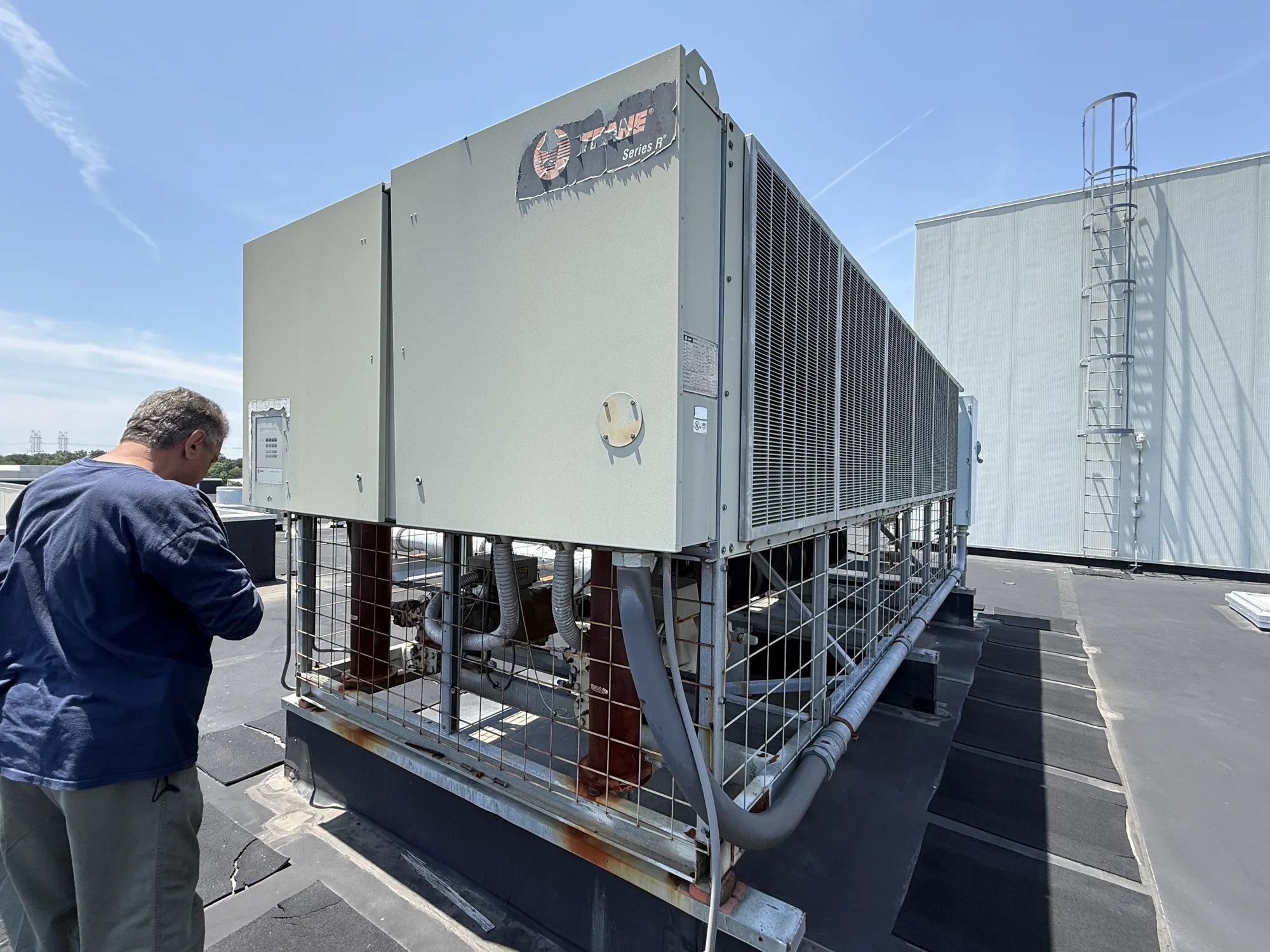
For an air-cooled chiller, a wide photo can show the cabinet, condenser coils, fans and the clearance around the machine. Note whether it is on a pad, roof, platform or inside a restricted area. Those details can affect the lifting path even when the unit's cooling capacity is already known.
Describe any barriers, overhead lines or structures along the intended removal route, and mention whether other equipment is close by. The seller need not test the chiller. We handle the agreed disconnects, refrigerant recovery, rigging and loading; the site contact can explain access constraints.
What to send for a useful equipment review
A full-unit photograph and a legible nameplate give us a starting point for identifying the chiller. Useful label details include manufacturer, model and serial numbers, rated capacity, voltage and refrigerant. Include accessible views of the controls and connections as well. Leave covers and guards in place rather than taking risks to obtain a photograph.
A unit may be connected, disconnected, incomplete or already retired; describe its actual condition rather than assuming that it must be operational. Mention known damage and any components that are absent. No testing is required, and you should not energize or operate equipment merely to request a quote. Existing records can help when a label is difficult to read.
How we evaluate an offer
Before valuing the proposed purchase, we need to know whether the description matches the equipment that will actually be released. Missing pieces, model and capacity, together with condition and configuration, can matter. So can the space for rigging, transportation and timing. These are review factors rather than a published price formula, and an inquiry may not result in an offer.
Before accepting an offer, review the identified equipment, the proposed payment and the removal scope. Payment is upfront under the agreed sale terms. We cover all freight and handle hauling, so a seller does not need to book a separate carrier for the chiller. Discuss the expected pickup window and any open access questions before scheduling.
From first details to an agreed pickup
A first message can be concise without pretending every detail is settled. Include your contact and company, location of the chiller, the person authorized to sell and the intended release window. Add the nameplate and equipment photos and any known type, capacity, refrigerant and voltage. If there are several units, match each specification to its own photograph.
A preliminary description lets us determine what additional information, if any, is needed. We may discuss photographs, condition or how the machine can leave the site. If we make an offer, review the equipment and removal terms; there is no guarantee of a proposal. After agreement we pay upfront and coordinate the listed work, including freight, for pickup.
Access, rigging and removal
Start at the unit and trace a possible path to the loading area in your photographs. Doors, corners, ramps, overhead restrictions and nearby equipment may all matter. Explain where a vehicle could approach and whether the machine is elevated or below grade. Share documented dimensions and weight if available, identifying an approximation as such.
The buyer handles crane work when needed, rigging, refrigerant recovery, disconnects, loading, freight and hauling. Tell us about electrical connections, water piping and other nearby systems that must remain in service. The site contact should explain its access rules and release requirements; we can then coordinate the agreed work and timing. No seller-performed testing is needed.
Frequently asked questions
Do disconnected machines need to be reconnected for review?
No. Tell us the chiller is disconnected and send available identification and site photos instead. We do not ask sellers to operate or test equipment to request an offer. Describe missing components and leave uncertain details marked as unknown.
Who organizes lifting and the trip away from the property?
We handle rigging, necessary crane work, loading, freight and hauling, as well as refrigerant recovery and disconnects, in the agreed removal scope. The buyer covers freight. The facility contact should explain restrictions and when access is available.
Why do access and condition matter to an offer?
They help define both the asset being purchased and the work needed to remove it. Model, configuration, completeness and schedule also matter. We buy chillers of all tonnages and using all refrigerants, but the review does not guarantee a price or an offer. Payment for an agreed sale is upfront.