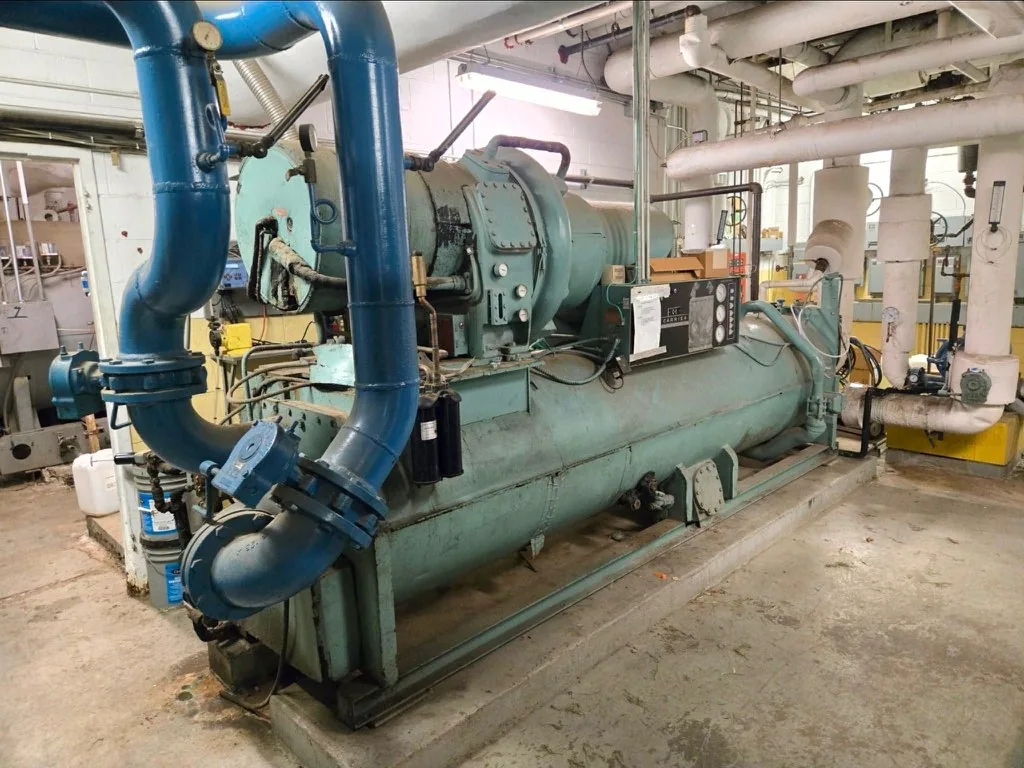
A practical way to sell your industrial chiller
Whether a chiller is still connected or has already been retired, its owner can ask us about a sale. We buy industrial chillers in Clarksville, Tennessee. With 500–999 ton chillers, we need an accurate picture of the equipment, its surroundings and the likely release window; a running demonstration is not required for our review.
The subject of this discussion is: 500–999 ton nameplate capacity and equipment rigging. A useful first step is to separate the confirmed details from those that require checking, whether they concern the chiller itself or the surrounding property.
We buy industrial chillers only: air-cooled and water-cooled machines, including centrifugal, screw and scroll units. Our scope includes equipment from 20 to 2,000 or more tons; we buy chillers of all tonnages and using all refrigerants. The equipment may come from decommissioned data centers and power plants, hospital and campus closures, or industrial plant shutdowns. We make cash offers and pay upfront under the agreed sale terms. Every proposal depends on the individual equipment and circumstances, so an offer or price is not guaranteed.
Capacity, dimensions and the lift plan
For a request concerning 500–999 ton chillers, give the rated cooling capacity shown on the nameplate if it is legible. Capacity in tons describes cooling output, not the machine's shipping weight. Two units in a similar capacity range can have different dimensions, access requirements or configurations.
A lifting discussion needs more than the capacity label. Share known dimensions and actual weight, images of the base and any marked lift points, and pictures of doorways and the loading area. Explain roof or ceiling restrictions. We handle rigging and crane work when needed, while the complete job rather than tonnage alone determines whether an offer is possible.
From first details to an agreed pickup
If you are preparing information for someone else to submit, gather the company and contact details, site location and authority to sell alongside the chiller photographs. Capacity, type, refrigerant and voltage are useful when known. Explain the anticipated removal date and whether it can move. A separate identification set for each unit prevents different machines from being confused.
The people who approve a sale and control a building may differ, so tell us whom to contact for each. We review the machine and may follow up about access. If an offer is made, check its scope before accepting. Payment is upfront under agreed terms, and removal and freight are then coordinated around the agreed release and access arrangements.
Access, rigging and removal
Photograph the path from the chiller to an exit or loading point, not just the machine itself. Include doorways, stairs or ramps, overhead obstructions, nearby equipment and the area where a truck could approach. If the unit is on a roof or below grade, say how that area is reached. Approximate dimensions and known weights are helpful, but mark estimates as estimates.
Once a purchase and scope are agreed, the buyer handles refrigerant recovery and disconnects as well as rigging, loading, freight and hauling. Crane work is included when needed. The facility should identify power and water connections, equipment that must remain operational, and its rules for granting access. The seller does not need to test the chiller for our review.
What to send for a useful equipment review
Start with a readable photo of the manufacturer's nameplate. The manufacturer, model, serial number, cooling capacity, voltage and refrigerant marking can help identify what is being offered. Add a full view of the chiller and, if accessible, photos of the controls, compressor area and visible connections. Do not remove guards or enter an unsafe area to take pictures.
Describe the unit as it stands today, even if it is disconnected, missing pieces or has not been operated recently. Known damage and existing service records can add context, particularly when a nameplate is hard to read. We do not require testing: do not start, energize or pressure-test the equipment simply to make an inquiry.
How we evaluate an offer
We consider more than the manufacturer or tonnage when evaluating a cash offer. The machine's configuration and visible condition, whether parts are present, the removal route and the requested schedule all help define the work. A complete description makes it easier to discuss a realistic quote, but a particular value or an offer is never automatic.
Read the proposed terms against the asset list and the site plan. Clarify what is included, who can grant access and what pickup window is anticipated. The buyer pays upfront under the agreed sale terms, covers all freight and handles hauling. Agreeing on these points helps avoid treating a tentative date as a confirmed appointment.
Frequently asked questions
The chiller has been shut down. Must it be restarted?
No. We do not require operation or testing for a quote. Send pictures of the equipment and its identification, and describe what you know about its present condition. Unknown history or specifications can be noted without energizing a retired machine.
What work does the buyer handle after a sale is agreed?
We handle refrigerant recovery, disconnects, necessary crane work, rigging, loading, freight and hauling; all freight is covered by the buyer. Describe the machine's connections and the route out so the team can coordinate removal with the facility's access requirements.
Does a higher capacity mean a fixed purchase price?
No. Tonnage describes output rather than weight or value. Condition, configuration, dimensions, site access and the proposed work also matter. We buy chillers of all tonnages and handle rigging and needed crane work, but each unit is evaluated and no offer or price is assured.