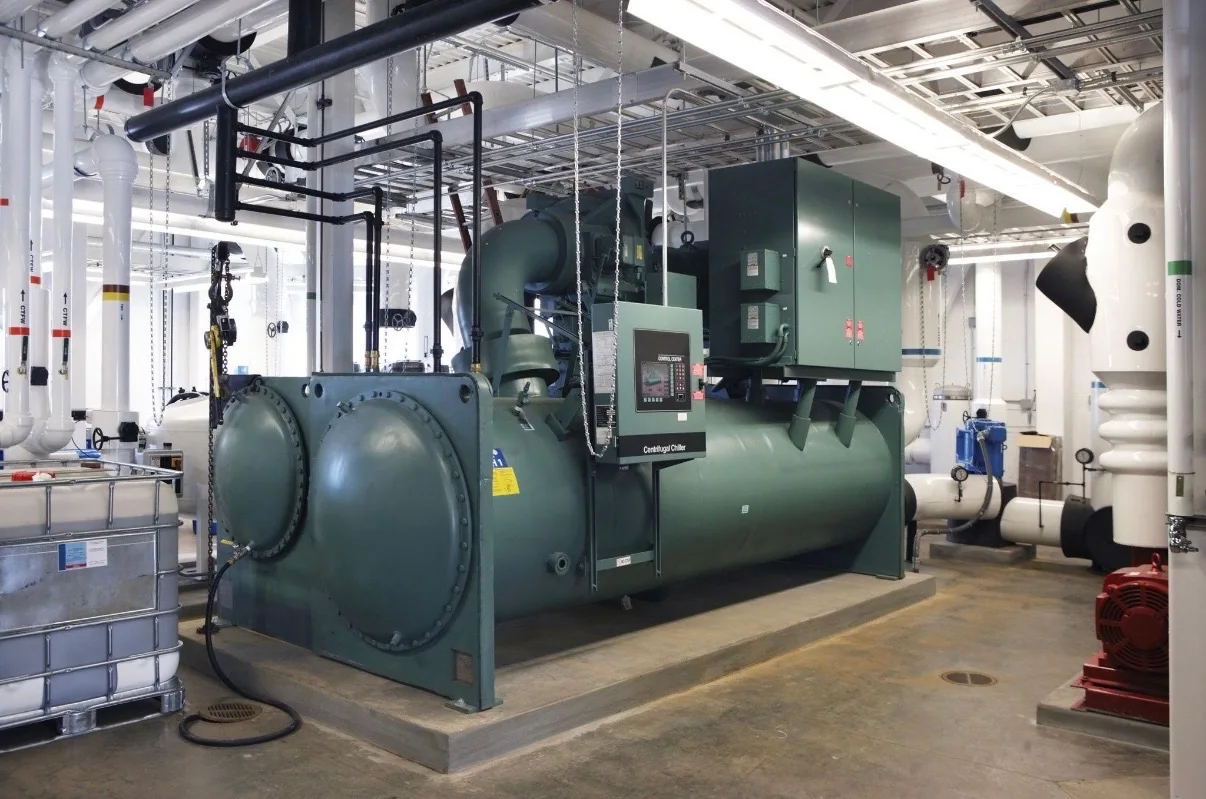
A practical way to sell your industrial chiller
Whether a chiller is still connected or has already been retired, its owner can ask us about a sale. We buy industrial chillers in Tennessee. With R-134a chillers, we need an accurate picture of the equipment, its surroundings and the likely release window; a running demonstration is not required for our review.
The topic can be summarized as follows: Identify R-134a on the equipment nameplate and plan buyer-handled recovery. Start with the equipment you actually intend to sell; give us the information you have and distinguish it from assumptions about the installation or its release date.
We purchase industrial chillers, including equipment released by data-center decommissioning, power-plant shutdowns, hospital and campus closures and industrial shutdowns. Both water-cooled and air-cooled machines can be considered, including scroll, screw and centrifugal types. We buy chillers of all tonnages and using all refrigerants, including units from 20 to 2,000 or more tons. Cash offers with upfront payment depend on review and agreed terms; no offer is assured.
Refrigerant identification and recovery
For a request concerning R-134a chillers, a clear photo of the refrigerant marking and equipment nameplate is more useful than an estimate based on age or appearance. If the marking is unreadable or you are unsure what is in the system, say so. We buy chillers using all refrigerants; the refrigerant designation by itself does not guarantee a particular offer.
If a service history describes a leak or earlier recovery, share that information with the equipment photos. Do not infer an empty system from the chiller's shutdown status and never vent refrigerant. The buyer handles recovery under the agreed removal plan; there is no need for the seller to test the machine to request a quote.
What to send for a useful equipment review
Think of the photographs as an identification set: one for the complete machine, one close enough to read the plate and, where safely reachable, others for controls and connections. The plate may give the manufacturer, serial and model numbers, cooling capacity, electrical voltage and refrigerant. Never expose energized parts or defeat guarding for a photo.
Describe the unit as it stands today, even if it is disconnected, missing pieces or has not been operated recently. Known damage and existing service records can add context, particularly when a nameplate is hard to read. We do not require testing: do not start, energize or pressure-test the equipment simply to make an inquiry.
Access, rigging and removal
Show where the machine sits in relation to the space around it, then photograph the way out and the area available for loading. Point out narrow openings, immovable objects, stairs or overhead barriers, and explain any controlled entrance. If known, give the unit's dimensions and weight. An uncertain measurement should remain an estimate, not a fact.
Our removal scope includes refrigerant recovery, disconnects, crane service when needed, rigging, loading, freight and hauling. Explain where the unit connects to power or water and whether neighboring equipment must stay in service. Site access and timing are coordinated with the appropriate contact. The seller does not have to test the machine before requesting a quote.
From first details to an agreed pickup
A first message can be concise without pretending every detail is settled. Include your contact and company, location of the chiller, the person authorized to sell and the intended release window. Add the nameplate and equipment photos and any known type, capacity, refrigerant and voltage. If there are several units, match each specification to its own photograph.
Our review may lead to follow-up questions about the unit, the access route or the date the site can release it. If we make an offer, the seller can review the proposed purchase and removal scope before accepting. Payment is upfront under the agreed terms, and we coordinate the removal and freight rather than asking the seller to arrange hauling.
How we evaluate an offer
A quote has to account for two connected questions: what is being bought, and what work is needed to take it away? Model, capacity, configuration, completeness and visible condition inform the equipment side. Disconnects, the exit route, freight and release date inform the logistics side. We review the whole situation; none of those details guarantees an offer or price.
The handoff should be clear before anyone schedules a truck. Review which chiller and components the agreement covers, when payment is due and the expected pickup window. We pay upfront according to the agreed terms and cover all freight and hauling. If the site's schedule depends on another party, bring that dependency into the discussion.
Frequently asked questions
What if we cannot demonstrate that the unit runs?
You can still send the available information. Seller testing is not required, and a machine should not be energized solely for our quotation. Identify the unit and explain its known condition or any gaps in the record; any offer is subject to review.
Must the seller disconnect the machine before pickup?
The buyer handles the agreed disconnects and refrigerant recovery, together with rigging, crane work when needed, loading, freight and hauling. All freight is covered. Identify power and water connections and any nearby systems that must remain in service.
Does the refrigerant type decide the cash offer?
We buy chillers using all refrigerants, but the designation alone does not guarantee a price or offer. Share a clear marking or note that it is unknown, along with the equipment and access details. The buyer handles recovery in the agreed scope.