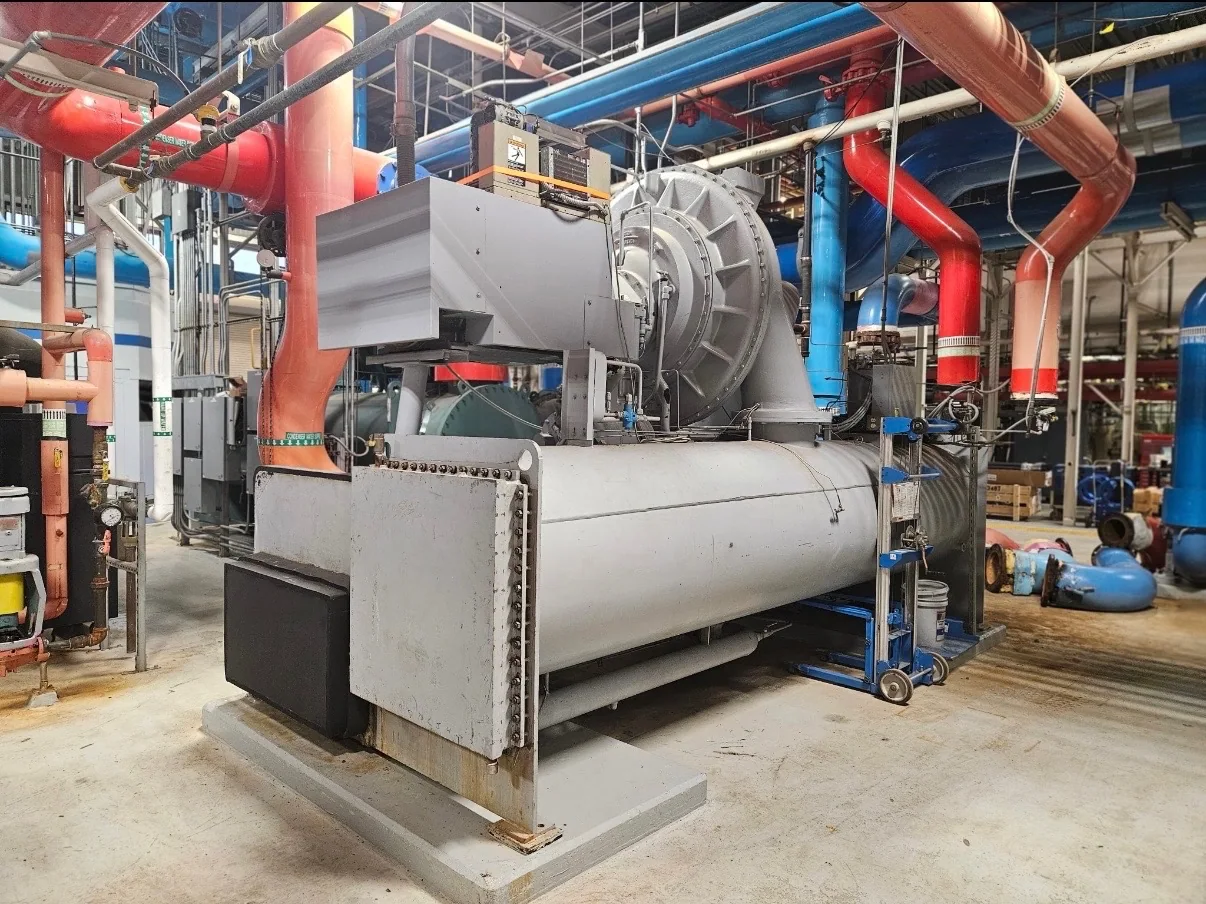
A practical way to sell your industrial chiller
A nameplate can tell part of the story; the route to a loading area tells another part. If you are considering selling used industrial chillers in Putnam County, Tennessee, share both equipment and site information. Our business buys industrial chillers, and each possible purchase is assessed on its own circumstances.
Consider the circumstances behind the request: County-wide equipment purchase and removal. An equipment label, a site photograph and a contact familiar with the property can help turn that broad description into a useful discussion.
We purchase industrial chillers, including equipment released by data-center decommissioning, power-plant shutdowns, hospital and campus closures and industrial shutdowns. Both water-cooled and air-cooled machines can be considered, including scroll, screw and centrifugal types. We buy chillers of all tonnages and using all refrigerants, including units from 20 to 2,000 or more tons. Cash offers with upfront payment depend on review and agreed terms; no offer is assured.
Documenting the path to a truck
A chiller's site in Putnam County, Tennessee may offer several possible exits, but the most direct-looking route is not necessarily workable for a large machine. Share pictures of doors, turns, slopes, overhead obstructions and the loading area. If available, provide dimensions and explain where a truck can approach.
Also point out fixed equipment or areas that must remain clear. These facts help the buyer plan rigging, loading and freight as part of the proposed work. You do not need to choose the lifting method yourself or promise a route that has not yet been evaluated.
Defining exactly what is for sale
At a property in Putnam County, Tennessee, a chiller may sit close to pumps, piping, controls or other cooling equipment. Mark the machine you intend to sell in your photographs and explain which associated components, if any, you want to discuss. Avoid describing an entire plant as one chiller if several separate items are present.
We buy industrial chillers; separate equipment should not be assumed to be part of the purchase. A defined boundary also helps identify the disconnects and the equipment that must remain in place. We handle the agreed removal work and evaluate the quote based on the actual scope.
How we evaluate an offer
In reviewing a possible cash purchase, we look at the unit as described and the practical work at its property. The nameplate, capacity and type help identify it; photographs and condition notes show what is present. Disconnects, access, transport and the release window also affect the review. We do not guarantee that every machine will receive an offer.
A seller considering an offer can ask how the scope, payment and pickup fit the proposed sale. Once terms are agreed, payment is upfront; we also cover freight and handle hauling. Confirm the actual equipment being transferred and the access arrangements so the work is planned around an agreed release, not an assumed one.
From first details to an agreed pickup
To begin, provide a contact name and company, the equipment location, and the type, tonnage, refrigerant and voltage shown on the chiller if known. Nameplate and full-unit photos help connect those details to the correct machine. Mention who can authorize the sale and your preferred release window; an unknown specification or tentative date can be marked as such.
Our review may lead to follow-up questions about the unit, the access route or the date the site can release it. If we make an offer, the seller can review the proposed purchase and removal scope before accepting. Payment is upfront under the agreed terms, and we coordinate the removal and freight rather than asking the seller to arrange hauling.
What to send for a useful equipment review
Start by locating the main equipment label and taking a clear, straight-on photo if it can be reached safely. Pair that with an image of the full chiller; show controls and connections where possible. Manufacturer, model, serial number, cooling rating, refrigerant and voltage are useful details, but do not open energized cabinets or move guards to read them.
Describe the unit as it stands today, even if it is disconnected, missing pieces or has not been operated recently. Known damage and existing service records can add context, particularly when a nameplate is hard to read. We do not require testing: do not start, energize or pressure-test the equipment simply to make an inquiry.
Access, rigging and removal
A good removal plan begins with the route out. Show the surrounding room, available openings, any overhead obstructions and the intended loading area. Tell us about roof access, restricted driveways or equipment that cannot be moved. If you have measurements or a documented weight, include them; if not, share clear photos rather than guessing.
Once a purchase and scope are agreed, the buyer handles refrigerant recovery and disconnects as well as rigging, loading, freight and hauling. Crane work is included when needed. The facility should identify power and water connections, equipment that must remain operational, and its rules for granting access. The seller does not need to test the chiller for our review.
Frequently asked questions
What should replace a test in my initial submission?
Provide a readable nameplate if available, a full view of the chiller and an honest description of its condition and location. We do not require a performance test and you should not energize the machine just to seek a quote.
Who organizes lifting and the trip away from the property?
We handle rigging, necessary crane work, loading, freight and hauling, as well as refrigerant recovery and disconnects, in the agreed removal scope. The buyer covers freight. The facility contact should explain restrictions and when access is available.
What determines whether I receive an offer?
We evaluate the specific chiller and the work involved, including its model, configuration, condition, completeness, location, access and schedule. We buy chillers of all tonnages and using all refrigerants, but neither a price nor an offer is guaranteed. If we agree to buy, payment is upfront under the agreed terms.