A practical way to sell your industrial chiller
An industrial chiller sale is more than a model number or a pickup date. For used industrial chillers in Benton County, Tennessee, we look at the equipment itself, the space around it and the work involved in removal. Our business buys industrial chillers; we are not offering chillers for sale.
For this discussion, keep the specific context in view: County-wide equipment purchase and removal. The right information depends on the machine and the facility, so share what you know and flag anything that remains uncertain.
We purchase industrial chillers, including equipment released by data-center decommissioning, power-plant shutdowns, hospital and campus closures and industrial shutdowns. Both water-cooled and air-cooled machines can be considered, including scroll, screw and centrifugal types. We buy chillers of all tonnages and using all refrigerants, including units from 20 to 2,000 or more tons. Cash offers with upfront payment depend on review and agreed terms; no offer is assured.
Making a realistic shutdown schedule
A planned shutdown and a firm release date are not always the same thing. If a chiller in Benton County, Tennessee will become available as part of a larger project, share the current target date and explain what it depends on. An estimated window is useful as long as it is identified as an estimate.
Let us know whether the site must keep other systems running, when access will be granted and who can confirm changes. We can discuss the equipment and logistics before a final date is set, then coordinate the agreed removal when the unit is released. A quote is evaluated rather than guaranteed.
Coordinating the sale and site access
The person authorized to sell a chiller is not always the same person who controls access to the property. For a site in Benton County, Tennessee, identify the owner or authorized seller and a facility contact who can answer practical questions about the machine's location and the removal route.
If a property manager, shutdown contractor or other party needs to approve the work window, tell us early. Clear points of contact help coordinate payment and pickup after an agreement. They do not require the seller to hire a hauler or run a test; the buyer handles the agreed removal work.
Access, rigging and removal
Access can change the work needed even when two chillers have similar ratings. Show the unit in its surroundings, the exit route, the space for lifting and the area where freight could be loaded. Mention narrow openings, obstructions, rooftop placement and site-controlled access. Measurements and equipment weights are useful when available, but they do not need to be invented.
The division of responsibility is straightforward: the buyer handles recovery of refrigerant, disconnects, crane work when required, rigging, loading, freight and hauling in the agreed scope. The site contact helps identify access conditions and the connections or neighboring systems that need consideration. There is no need to run a chiller to ask for an offer.
From first details to an agreed pickup
You can begin before every record has been located. Share your contact and company, the chiller's location and the name of the person able to authorize a sale. Include a photo of the label and machine, its known type, capacity, refrigerant and voltage, and the expected release date. Flag flexible timing and identify each chiller separately if there is more than one.
The people who approve a sale and control a building may differ, so tell us whom to contact for each. We review the machine and may follow up about access. If an offer is made, check its scope before accepting. Payment is upfront under agreed terms, and removal and freight are then coordinated around the agreed release and access arrangements.
How we evaluate an offer
Before valuing the proposed purchase, we need to know whether the description matches the equipment that will actually be released. Missing pieces, model and capacity, together with condition and configuration, can matter. So can the space for rigging, transportation and timing. These are review factors rather than a published price formula, and an inquiry may not result in an offer.
The handoff should be clear before anyone schedules a truck. Review which chiller and components the agreement covers, when payment is due and the expected pickup window. We pay upfront according to the agreed terms and cover all freight and hauling. If the site's schedule depends on another party, bring that dependency into the discussion.
What to send for a useful equipment review
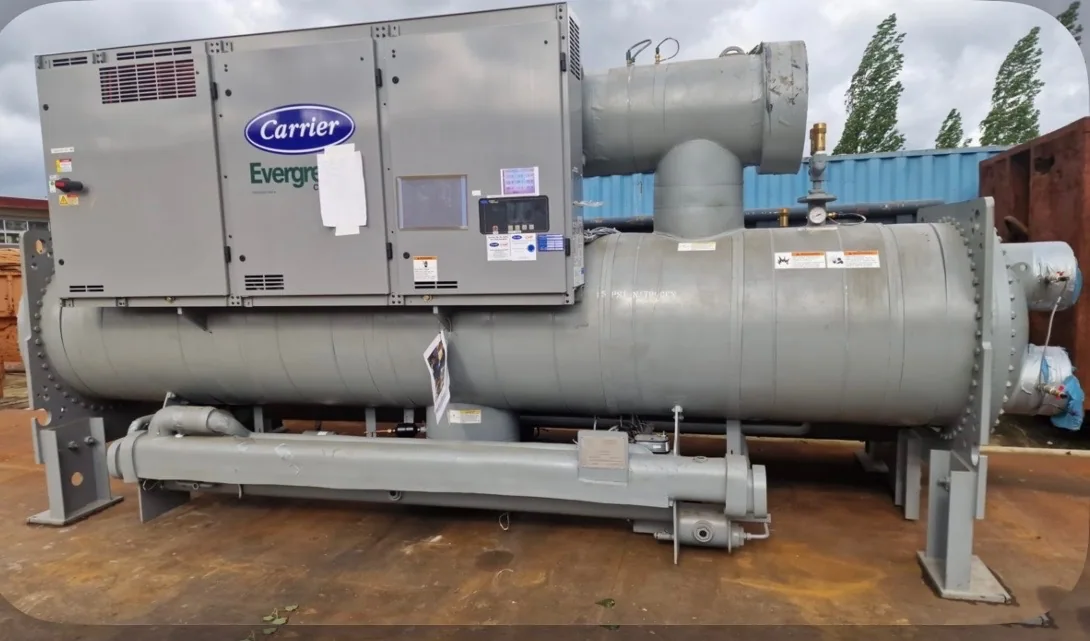
Think of the photographs as an identification set: one for the complete machine, one close enough to read the plate and, where safely reachable, others for controls and connections. The plate may give the manufacturer, serial and model numbers, cooling capacity, electrical voltage and refrigerant. Never expose energized parts or defeat guarding for a photo.
Tell us what you know about condition, missing components and whether the machine is still connected. If the plate is damaged, send the clearest available image and any records you have. We do not require testing: please do not start, energize or pressure-test a chiller just to seek an offer. An unknown detail can be described as unknown.
Frequently asked questions
Should we run a performance test before sending photos?
No. Our buying process does not require a seller to run a test. Provide the equipment identification, visible condition and available site details. If the unit has already been shut down or a specification is unknown, say so rather than operating equipment for the quote.
Will the seller need to arrange removal and transportation?
No. We handle disconnects, refrigerant recovery, rigging, crane work when needed, loading and hauling, and we cover all freight. The site contact can help by explaining access, release dates and any systems that must remain in place. Removal is coordinated under the agreed scope.
When is payment made if we agree to sell?
We pay upfront under the agreed sale terms. Before acceptance, review the equipment included, payment arrangements and removal scope. The individual machine and site are evaluated first, so a cash offer or particular price is not automatic.