A practical way to sell your industrial chiller
Selling an industrial chiller starts with two questions: what is the equipment, and what will it take to remove it safely? We buy industrial chillers in Kingsport, Tennessee. For a request concerning R-407C chillers, photographs and honest site details help us assess the machine and prepare a practical cash offer.
The subject of this discussion is: R-407C identification and buyer-handled recovery. A useful first step is to separate the confirmed details from those that require checking, whether they concern the chiller itself or the surrounding property.
Our buying scope is industrial chillers only. It includes air-cooled and water-cooled units, whether equipped with centrifugal, screw or scroll compressors. We buy chillers of all tonnages and using all refrigerants, including units from 20 to 2,000 or more tons. Data centers, power plants, hospitals, campuses and industrial plants are examples of decommissioning sources. We make cash offers and pay upfront under agreed terms; an individual offer is not guaranteed.
Refrigerant identification and recovery
For a request concerning R-407C chillers, a clear photo of the refrigerant marking and equipment nameplate is more useful than an estimate based on age or appearance. If the marking is unreadable or you are unsure what is in the system, say so. We buy chillers using all refrigerants; the refrigerant designation by itself does not guarantee a particular offer.
A previous shutdown does not by itself establish what remains in a system. Share known leak or recovery history and any documentation already on hand. We handle refrigerant recovery within the agreed removal work. Do not vent the refrigerant or assume the circuit is empty; a quote does not require testing.
What to send for a useful equipment review
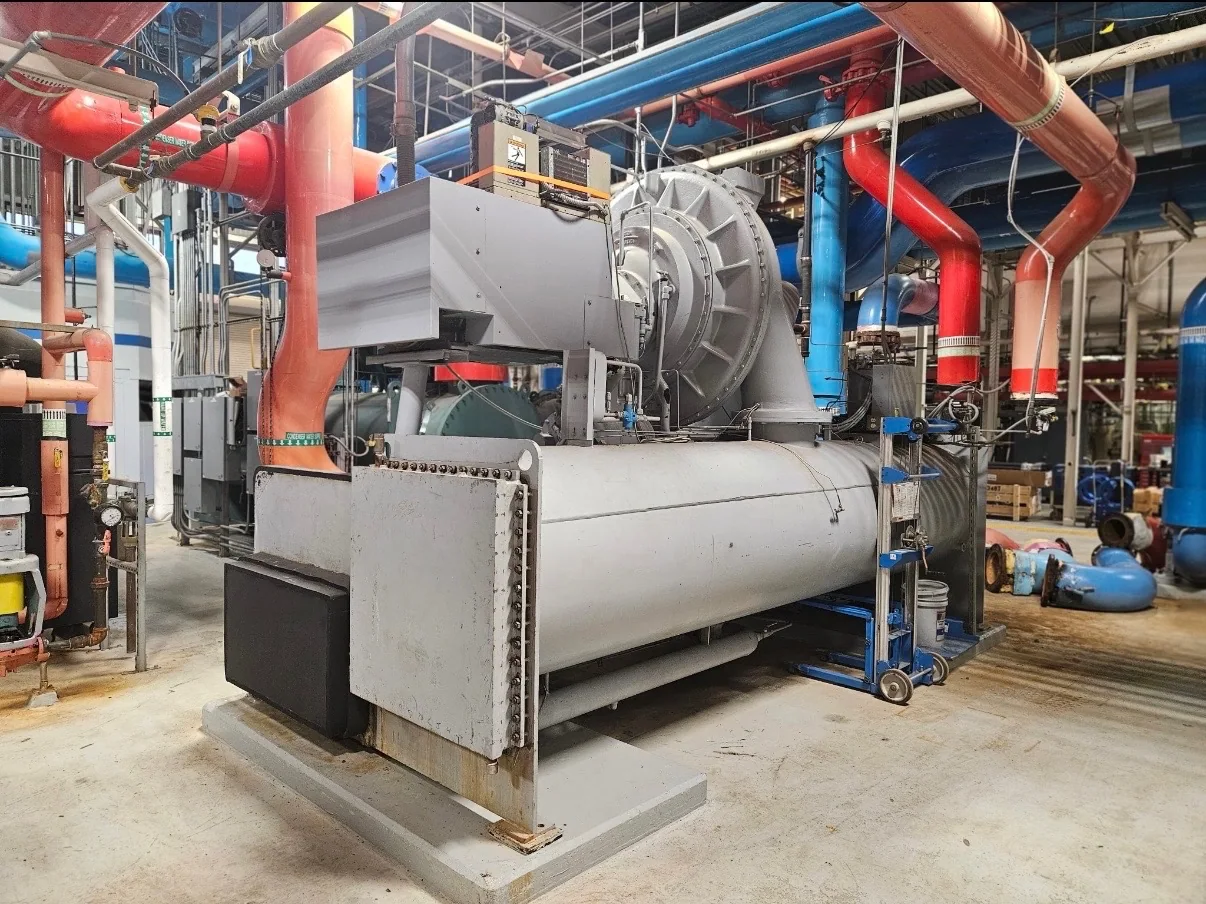
If all you have at first is a building inventory, compare it with the markings on the chiller itself. We can use a readable nameplate showing the maker, model, serial number, tonnage, voltage and refrigerant, along with a photograph of the complete unit. Show accessible controls and connections too, without disturbing covers or entering hazardous spaces.
A unit may be connected, disconnected, incomplete or already retired; describe its actual condition rather than assuming that it must be operational. Mention known damage and any components that are absent. No testing is required, and you should not energize or operate equipment merely to request a quote. Existing records can help when a label is difficult to read.
Access, rigging and removal
Access can change the work needed even when two chillers have similar ratings. Show the unit in its surroundings, the exit route, the space for lifting and the area where freight could be loaded. Mention narrow openings, obstructions, rooftop placement and site-controlled access. Measurements and equipment weights are useful when available, but they do not need to be invented.
Our removal scope includes refrigerant recovery, disconnects, crane service when needed, rigging, loading, freight and hauling. Explain where the unit connects to power or water and whether neighboring equipment must stay in service. Site access and timing are coordinated with the appropriate contact. The seller does not have to test the machine before requesting a quote.
From first details to an agreed pickup
To begin, provide a contact name and company, the equipment location, and the type, tonnage, refrigerant and voltage shown on the chiller if known. Nameplate and full-unit photos help connect those details to the correct machine. Mention who can authorize the sale and your preferred release window; an unknown specification or tentative date can be marked as such.
The people who approve a sale and control a building may differ, so tell us whom to contact for each. We review the machine and may follow up about access. If an offer is made, check its scope before accepting. Payment is upfront under agreed terms, and removal and freight are then coordinated around the agreed release and access arrangements.
How we evaluate an offer
A cash offer is evaluated using the chiller's identification, capacity, configuration, visible condition and completeness, along with the practical costs and timing of removal. Access for equipment and trucks, the work required to disconnect the unit, and the destination for the load can all matter. None of these factors alone determines the price, and not every inquiry results in an offer.
If we propose a purchase, check that the offer identifies the correct machine and states the agreed payment and removal arrangements. Our payment is upfront under the sale terms; we cover freight and handle hauling. Before setting the work window, identify the person who can release the equipment and raise any unresolved site-access questions.
Frequently asked questions
Can I inquire without current performance readings?
Yes. A performance test is not a condition of our review. The nameplate, overall photographs, known condition and site details are a useful starting point. Do not start or energize the chiller simply to obtain readings for the request.
What should the facility contribute to removal planning?
Explain the route, connections, access rules and release window. We handle refrigerant recovery, disconnects, rigging, loading and hauling; crane work is handled when needed and all freight is covered. The site should identify neighboring equipment that must stay in place or service.
Can I submit an inquiry if the system may have a leak?
Yes. Report any known leak and share the refrigerant marking or available records. Do not vent the contents or assume that a leak means the system is empty. We handle refrigerant recovery as part of agreed removal; the equipment still requires review.