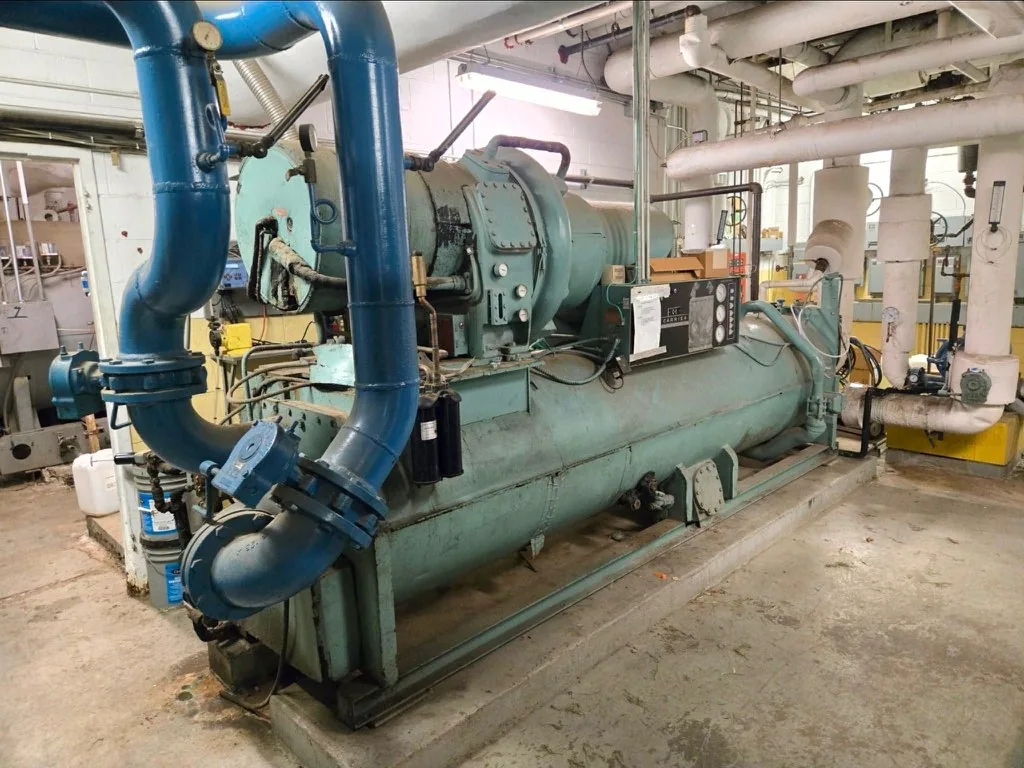
A practical way to sell your industrial chiller
If you have an industrial chiller to remove in Kingsport, Tennessee, you do not need to make it operational before contacting us. We buy industrial chillers and can evaluate a request concerning Trane chillers using the equipment details, available photographs and the conditions at the site.
The request has a specific focus: Trane chiller identity, configuration, access and removal. Tell us which parts of the situation are settled and which depend on a facility contact or an upcoming project milestone.
From a 20-ton unit to equipment rated 2,000 tons or more, our industrial chiller buying scope covers all tonnages and all refrigerants. We consider air-cooled and water-cooled chillers, including centrifugal, screw and scroll machines. Shutdowns at industrial plants, campuses, hospitals, power plants and data centers can produce surplus units. We make cash offers and pay upfront on agreed terms; the equipment and removal must first be evaluated.
Manufacturer and model details
Not every seller has the original documentation for Trane chillers. Begin with a wide, safely obtained photograph and the best available image of the identification plate. If the plate is worn, any existing service record or drawing may help clarify the model. Leave uncertain markings uninterpreted rather than supplying an invented number.
Tell us what can be observed: whether the machine is connected, which components appear absent and what changes have been made, if known. The manufacturer's name alone does not establish value. We review the physical equipment alongside access and removal needs before deciding whether a cash proposal is possible.
What to send for a useful equipment review
Think of the photographs as an identification set: one for the complete machine, one close enough to read the plate and, where safely reachable, others for controls and connections. The plate may give the manufacturer, serial and model numbers, cooling capacity, electrical voltage and refrigerant. Never expose energized parts or defeat guarding for a photo.
The absence of a readable plate or a complete history is worth flagging, not concealing. Provide available records and photographs, indicate whether the chiller is connected and identify missing components or known damage. If you do not know a specification, say so. The seller is not required to run or test the equipment for our evaluation.
From first details to an agreed pickup
A useful inquiry pairs your contact and company information with the chiller's location and identification. Send photos, capacity, type, voltage and refrigerant details where available, and identify the authorized seller. Add the anticipated pickup window and label each machine if more than one is involved. It is fine to say when a field or date is not yet known.
Once the equipment and location details are received, we review them and may ask about gaps in the record or the removal route. If we make an offer, the seller can consider the purchase and work scope before accepting. After agreement, payment is upfront on the agreed terms and pickup is coordinated with the site. We handle the removal and freight described in that scope.
How we evaluate an offer
Before valuing the proposed purchase, we need to know whether the description matches the equipment that will actually be released. Missing pieces, model and capacity, together with condition and configuration, can matter. So can the space for rigging, transportation and timing. These are review factors rather than a published price formula, and an inquiry may not result in an offer.
The handoff should be clear before anyone schedules a truck. Review which chiller and components the agreement covers, when payment is due and the expected pickup window. We pay upfront according to the agreed terms and cover all freight and hauling. If the site's schedule depends on another party, bring that dependency into the discussion.
Access, rigging and removal
Access can change the work needed even when two chillers have similar ratings. Show the unit in its surroundings, the exit route, the space for lifting and the area where freight could be loaded. Mention narrow openings, obstructions, rooftop placement and site-controlled access. Measurements and equipment weights are useful when available, but they do not need to be invented.
Once a purchase and scope are agreed, the buyer handles refrigerant recovery and disconnects as well as rigging, loading, freight and hauling. Crane work is included when needed. The facility should identify power and water connections, equipment that must remain operational, and its rules for granting access. The seller does not need to test the chiller for our review.
Frequently asked questions
Can I request an offer if the unit is not running?
Yes. No testing is required, and you should not start or energize the chiller just for our review. Share the nameplate, photos and what you know about its condition and connections. We evaluate the information rather than assuming that every inquiry results in an offer.
What should the facility contribute to removal planning?
Explain the route, connections, access rules and release window. We handle refrigerant recovery, disconnects, rigging, loading and hauling; crane work is handled when needed and all freight is covered. The site should identify neighboring equipment that must stay in place or service.
What determines whether I receive an offer?
We evaluate the specific chiller and the work involved, including its model, configuration, condition, completeness, location, access and schedule. We buy chillers of all tonnages and using all refrigerants, but neither a price nor an offer is guaranteed. If we agree to buy, payment is upfront under the agreed terms.