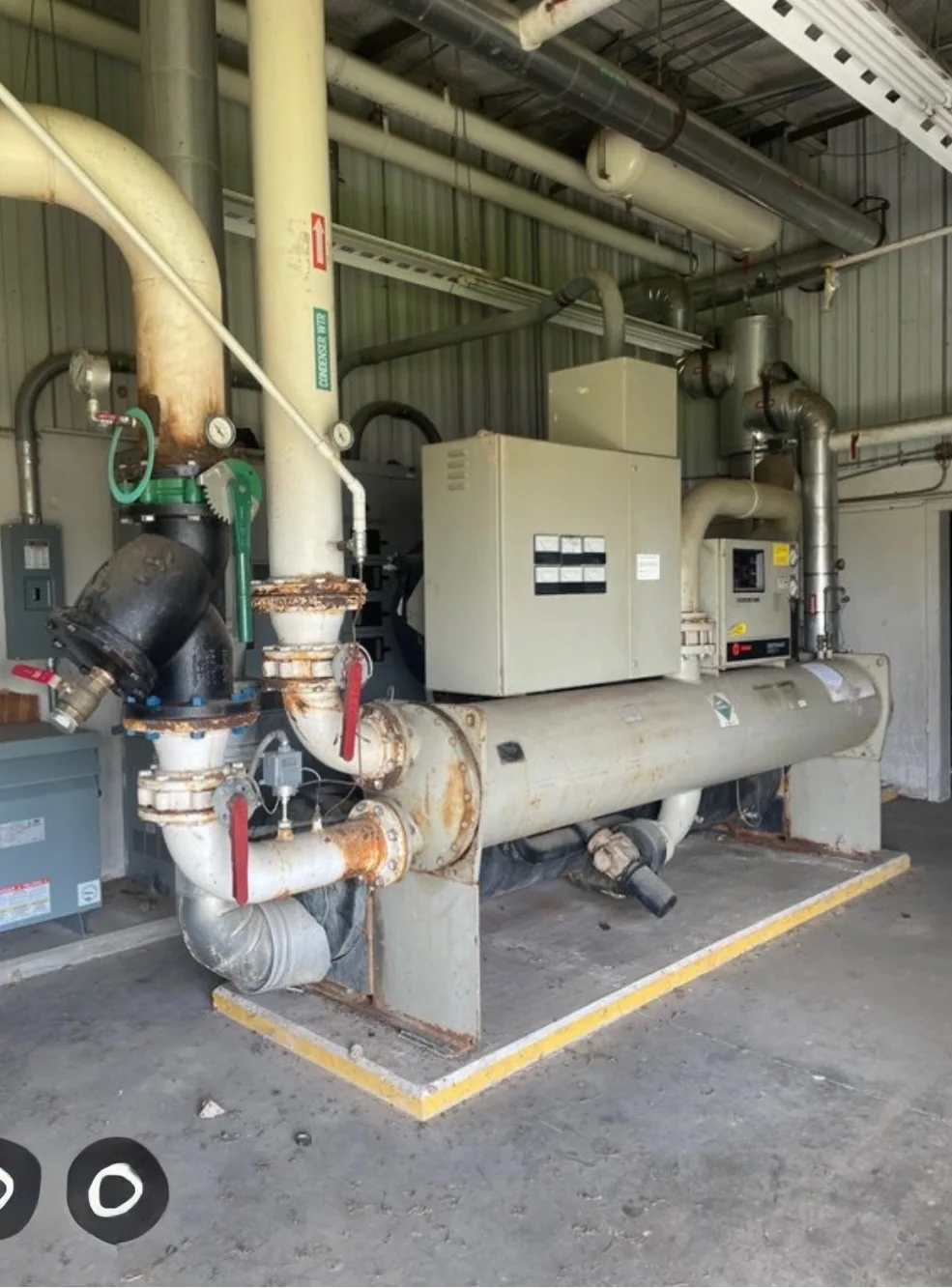
A practical way to sell your industrial chiller
An owner considering the sale of R-123 chillers in Nashville, Tennessee can start with the information already at hand. Send clear pictures and describe where the chiller sits. We buy industrial chillers and evaluate both the machine and the practical work involved before deciding whether to propose a cash offer.
Each project has its own boundaries. Keep this focus in mind: R-123 identification and buyer-handled recovery. Identify the machine, the responsible contact and any open questions before making decisions about access or timing.
Our buying scope is industrial chillers only. It includes air-cooled and water-cooled units, whether equipped with centrifugal, screw or scroll compressors. We buy chillers of all tonnages and using all refrigerants, including units from 20 to 2,000 or more tons. Data centers, power plants, hospitals, campuses and industrial plants are examples of decommissioning sources. We make cash offers and pay upfront under agreed terms; an individual offer is not guaranteed.
Refrigerant identification and recovery
For a request concerning R-123 chillers, a clear photo of the refrigerant marking and equipment nameplate is more useful than an estimate based on age or appearance. If the marking is unreadable or you are unsure what is in the system, say so. We buy chillers using all refrigerants; the refrigerant designation by itself does not guarantee a particular offer.
Do not vent refrigerant or assume the system is empty. The buyer handles refrigerant recovery as part of the agreed removal process, with appropriate planning for the equipment and applicable requirements. Mention any known leak, previous recovery or available service records, but do not run a test just to request a quote.
Access, rigging and removal
Start at the unit and trace a possible path to the loading area in your photographs. Doors, corners, ramps, overhead restrictions and nearby equipment may all matter. Explain where a vehicle could approach and whether the machine is elevated or below grade. Share documented dimensions and weight if available, identifying an approximation as such.
For the agreed work, we take responsibility for disconnects, refrigerant recovery, rigging and loading, using a crane when needed; we also handle freight and hauling. Tell the coordinating contact about site rules and the unit's electrical and water connections, including any systems that must remain available. The quote request does not call for a seller-performed test.
How we evaluate an offer
We consider more than the manufacturer or tonnage when evaluating a cash offer. The machine's configuration and visible condition, whether parts are present, the removal route and the requested schedule all help define the work. A complete description makes it easier to discuss a realistic quote, but a particular value or an offer is never automatic.
Before accepting an offer, review the identified equipment, the proposed payment and the removal scope. Payment is upfront under the agreed sale terms. We cover all freight and handle hauling, so a seller does not need to book a separate carrier for the chiller. Discuss the expected pickup window and any open access questions before scheduling.
From first details to an agreed pickup
A first message can be concise without pretending every detail is settled. Include your contact and company, location of the chiller, the person authorized to sell and the intended release window. Add the nameplate and equipment photos and any known type, capacity, refrigerant and voltage. If there are several units, match each specification to its own photograph.
First we assess the submitted information; then any unresolved equipment or access questions can be discussed. A seller is free to review an offer, if made, and its stated removal scope before accepting it. An agreed sale moves to upfront payment and pickup coordination. We handle the agreed physical removal and cover the freight rather than requiring a seller-booked carrier.
What to send for a useful equipment review
Start by locating the main equipment label and taking a clear, straight-on photo if it can be reached safely. Pair that with an image of the full chiller; show controls and connections where possible. Manufacturer, model, serial number, cooling rating, refrigerant and voltage are useful details, but do not open energized cabinets or move guards to read them.
Separate an observation from an operating claim. If you can see damage or know that a part was removed, explain that; if the service history is unavailable, say so. Let us know whether the unit is attached to its connections. We do not ask sellers to energize, run or pressure-test it, and existing records can supplement an unreadable plate.
Frequently asked questions
Do disconnected machines need to be reconnected for review?
No. Tell us the chiller is disconnected and send available identification and site photos instead. We do not ask sellers to operate or test equipment to request an offer. Describe missing components and leave uncertain details marked as unknown.
What work does the buyer handle after a sale is agreed?
We handle refrigerant recovery, disconnects, necessary crane work, rigging, loading, freight and hauling; all freight is covered by the buyer. Describe the machine's connections and the route out so the team can coordinate removal with the facility's access requirements.
Does the refrigerant type decide the cash offer?
We buy chillers using all refrigerants, but the designation alone does not guarantee a price or offer. Share a clear marking or note that it is unknown, along with the equipment and access details. The buyer handles recovery in the agreed scope.