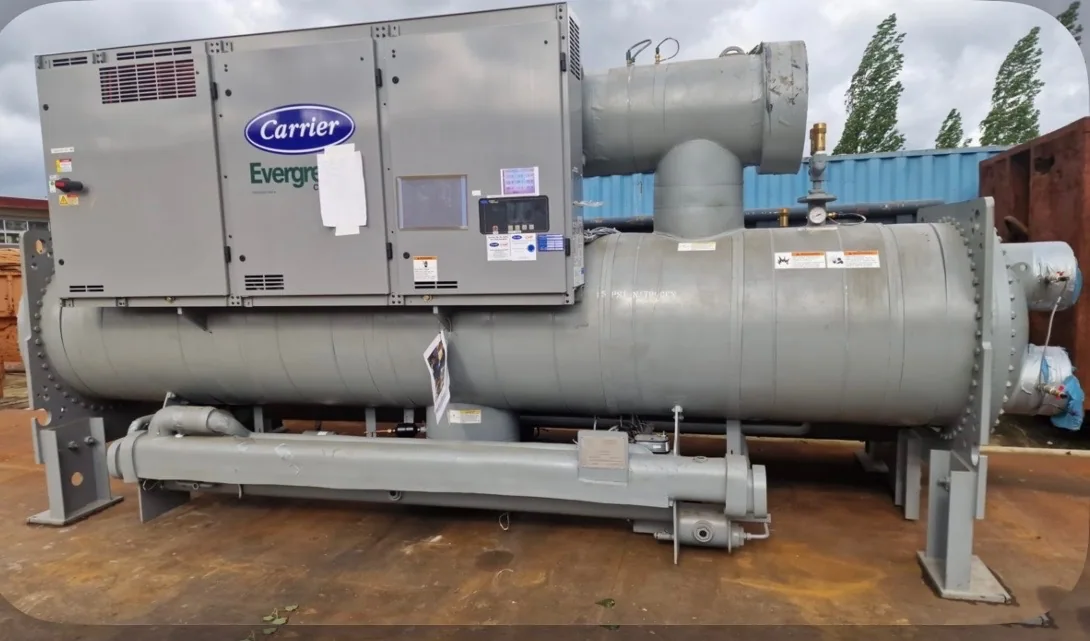
A practical way to sell your industrial chiller
Whether a chiller is still connected or has already been retired, its owner can ask us about a sale. We buy industrial chillers in Nashville, Tennessee. With Carrier centrifugal chillers, we need an accurate picture of the equipment, its surroundings and the likely release window; a running demonstration is not required for our review.
Each project has its own boundaries. Keep this focus in mind: Carrier manufacturer identification and centrifugal equipment configuration. Identify the machine, the responsible contact and any open questions before making decisions about access or timing.
Our business buys industrial chillers only, including air-cooled and water-cooled machines with centrifugal, screw or scroll compressors. Equipment from 20 to 2,000+ tons is included, and we buy chillers of all tonnages and using all refrigerants. Sources can include data center decommissioning, power plant shutdowns, hospital or campus closures and industrial plant shutdown projects. A seller may receive a cash offer, with upfront payment under agreed terms. The machine and logistics must be evaluated first; no particular offer is promised.
Manufacturer and model details
A useful description of Carrier centrifugal chillers separates identification from assumptions about operation. Send the model, serial number and other details visible on the main nameplate, together with a view showing the complete machine. Where a label cannot be read, an existing document or clearer safe photograph is more useful than a guessed specification.
Also say what you want included in the sale. Nearby controls, piping or other machines should not automatically be treated as part of the chiller. Mention visible damage and known modifications. We assess that scope together with site conditions, and the manufacturer's identity does not on its own guarantee a purchase.
Understanding the equipment configuration
A useful equipment description starts with the configuration: air-cooled or water-cooled, and centrifugal, screw or scroll when known. Photograph a centrifugal machine, including the compressor assembly, controls and any separate components. If you do not know the type, the nameplate and a full-unit photo are a practical starting point; an uncertain label is not a reason to run the machine.
The configuration affects what the site contact needs to show. For a water-cooled machine, identify its water connections and any shared loops. For an air-cooled unit, photograph the condenser and available clearance. Mark the actual chiller for sale and specify what equipment will remain, rather than assuming the whole installation is included.
From first details to an agreed pickup
You can begin before every record has been located. Share your contact and company, the chiller's location and the name of the person able to authorize a sale. Include a photo of the label and machine, its known type, capacity, refrigerant and voltage, and the expected release date. Flag flexible timing and identify each chiller separately if there is more than one.
First we assess the submitted information; then any unresolved equipment or access questions can be discussed. A seller is free to review an offer, if made, and its stated removal scope before accepting it. An agreed sale moves to upfront payment and pickup coordination. We handle the agreed physical removal and cover the freight rather than requiring a seller-booked carrier.
What to send for a useful equipment review
Make the identification images easy to match to the asset. A close view of the main plate may show the manufacturer, model, serial number, capacity, voltage and refrigerant; a separate wide view shows the whole chiller. If safe access permits, add controls and connection photographs. Do not open electrical enclosures or remove protective guards to obtain them.
Separate an observation from an operating claim. If you can see damage or know that a part was removed, explain that; if the service history is unavailable, say so. Let us know whether the unit is attached to its connections. We do not ask sellers to energize, run or pressure-test it, and existing records can supplement an unreadable plate.
Access, rigging and removal
The distance from a chiller to a truck is only one part of the route. Changes in floor level, door sizes, overhead structures and fixed equipment can affect the work. If the machine is on a roof or below grade, explain how that location is accessed. Photos and any reliable dimensions or weight help identify questions; estimates should be labeled.
The division of responsibility is straightforward: the buyer handles recovery of refrigerant, disconnects, crane work when required, rigging, loading, freight and hauling in the agreed scope. The site contact helps identify access conditions and the connections or neighboring systems that need consideration. There is no need to run a chiller to ask for an offer.
How we evaluate an offer
A useful valuation discussion starts with facts, not an assumed price per ton. Provide the model and configuration, visible condition and whether components are complete, then describe the removal route and available timing. We consider the chiller and the associated work as one proposed transaction. Each case is evaluated and neither a price nor an offer is guaranteed.
If an offer is made and accepted, we pay upfront as set out in the agreed sale terms. Confirm the equipment included, payment arrangements and anticipated removal window before the work is scheduled. We cover all freight and handle hauling; the quote should make the agreed scope clear so both sides know what is being purchased and removed.
Frequently asked questions
What should replace a test in my initial submission?
Provide a readable nameplate if available, a full view of the chiller and an honest description of its condition and location. We do not require a performance test and you should not energize the machine just to seek a quote.
Who handles refrigerant, rigging and freight?
The buyer handles refrigerant recovery, disconnects, crane work when needed, rigging, loading, freight and hauling. We cover all freight. Tell us about the site's access rules and the equipment's connections so those activities can be coordinated within the agreed removal plan.
Can you quote a price from the nameplate alone?
The nameplate is useful, but condition, completeness, access and removal timing also enter the review. We buy industrial chillers of all tonnages and using all refrigerants, yet no price or offer is guaranteed. If a sale is agreed, payment is upfront on the agreed terms.