A practical way to sell your industrial chiller
An industrial chiller sale is more than a model number or a pickup date. For York chillers in Jackson, Tennessee, we look at the equipment itself, the space around it and the work involved in removal. Our business buys industrial chillers; we are not offering chillers for sale.
The topic can be summarized as follows: York chiller identity, configuration, access and removal. Start with the equipment you actually intend to sell; give us the information you have and distinguish it from assumptions about the installation or its release date.
We buy industrial chillers only: air-cooled and water-cooled machines, including centrifugal, screw and scroll units. Our scope includes equipment from 20 to 2,000 or more tons; we buy chillers of all tonnages and using all refrigerants. The equipment may come from decommissioned data centers and power plants, hospital and campus closures, or industrial plant shutdowns. We make cash offers and pay upfront under the agreed sale terms. Every proposal depends on the individual equipment and circumstances, so an offer or price is not guaranteed.
Manufacturer and model details
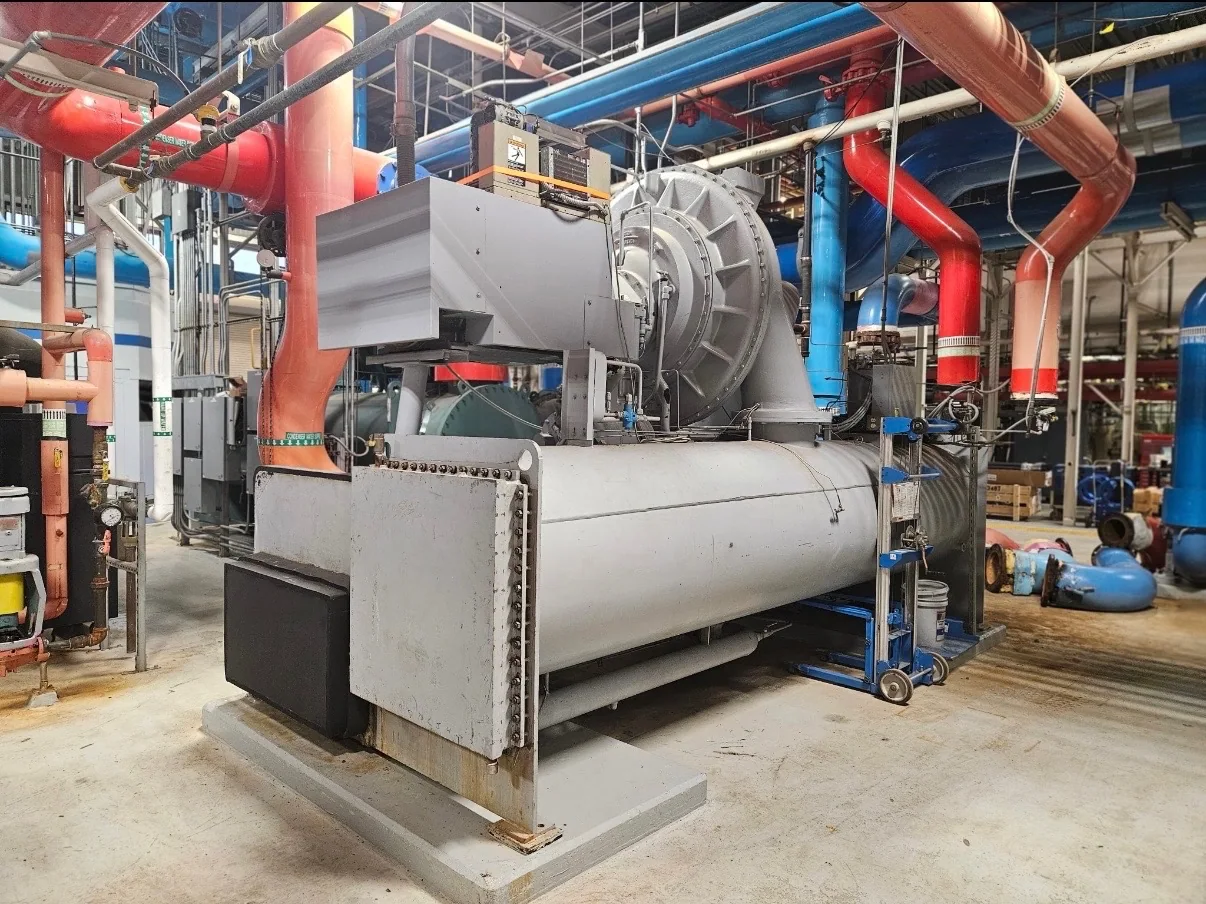
The words York chillers identify a category, not a complete specification. A close view of the plate and a wider view of the whole chiller help connect the manufacturer's name to its model and serial number. Include safely reachable control or compressor labels if useful, and flag any missing or illegible information.
Describe the current machine rather than a typical example: its visible condition, any missing pieces or changes, and the surrounding equipment that will not be sold. The access route and work required also form part of our review. No particular price or offer follows from the brand alone.
Access, rigging and removal
The distance from a chiller to a truck is only one part of the route. Changes in floor level, door sizes, overhead structures and fixed equipment can affect the work. If the machine is on a roof or below grade, explain how that location is accessed. Photos and any reliable dimensions or weight help identify questions; estimates should be labeled.
You do not need to arrange a freight carrier or rigging crew for the agreed purchase. We handle crane work as needed, refrigerant recovery, disconnects, rigging, loading, freight and hauling. Describe the electrical and water connections and any adjacent systems that need protection. A site contact can help coordinate access and release; no seller testing is required.
How we evaluate an offer
In reviewing a possible cash purchase, we look at the unit as described and the practical work at its property. The nameplate, capacity and type help identify it; photographs and condition notes show what is present. Disconnects, access, transport and the release window also affect the review. We do not guarantee that every machine will receive an offer.
If we propose a purchase, check that the offer identifies the correct machine and states the agreed payment and removal arrangements. Our payment is upfront under the sale terms; we cover freight and handle hauling. Before setting the work window, identify the person who can release the equipment and raise any unresolved site-access questions.
From first details to an agreed pickup
To begin, provide a contact name and company, the equipment location, and the type, tonnage, refrigerant and voltage shown on the chiller if known. Nameplate and full-unit photos help connect those details to the correct machine. Mention who can authorize the sale and your preferred release window; an unknown specification or tentative date can be marked as such.
Once the equipment and location details are received, we review them and may ask about gaps in the record or the removal route. If we make an offer, the seller can consider the purchase and work scope before accepting. After agreement, payment is upfront on the agreed terms and pickup is coordinated with the site. We handle the removal and freight described in that scope.
What to send for a useful equipment review
The words on a nameplate help connect the offered chiller to its actual specification. Photograph the maker, model and serial number, rated tons, voltage and refrigerant marking if legible. A whole-machine picture and safe views of connections and controls add context. If taking an image would require removing a cover or entering an unsafe space, leave it out.
Describe the unit as it stands today, even if it is disconnected, missing pieces or has not been operated recently. Known damage and existing service records can add context, particularly when a nameplate is hard to read. We do not require testing: do not start, energize or pressure-test the equipment simply to make an inquiry.
Frequently asked questions
The chiller has been shut down. Must it be restarted?
No. We do not require operation or testing for a quote. Send pictures of the equipment and its identification, and describe what you know about its present condition. Unknown history or specifications can be noted without energizing a retired machine.
Who handles refrigerant, rigging and freight?
The buyer handles refrigerant recovery, disconnects, crane work when needed, rigging, loading, freight and hauling. We cover all freight. Tell us about the site's access rules and the equipment's connections so those activities can be coordinated within the agreed removal plan.
Can you quote a price from the nameplate alone?
The nameplate is useful, but condition, completeness, access and removal timing also enter the review. We buy industrial chillers of all tonnages and using all refrigerants, yet no price or offer is guaranteed. If a sale is agreed, payment is upfront on the agreed terms.