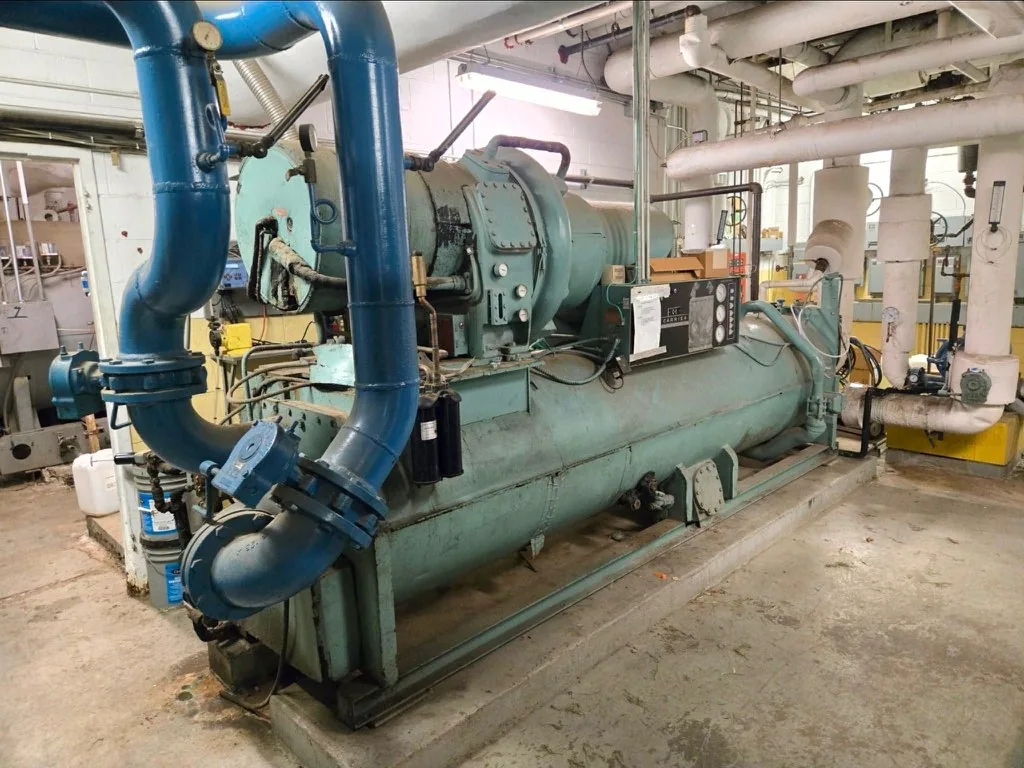
A practical way to sell your industrial chiller
A nameplate can tell part of the story; the route to a loading area tells another part. If you are considering selling Trane water-cooled chillers in Murfreesboro, Tennessee, share both equipment and site information. Our business buys industrial chillers, and each possible purchase is assessed on its own circumstances.
Use this page as a starting point for the following: Trane manufacturer identification and water-cooled equipment configuration. The particular nameplate, condition and site constraints matter more than a general description; uncertain details can be discussed rather than guessed.
Our buying scope is industrial chillers only. It includes air-cooled and water-cooled units, whether equipped with centrifugal, screw or scroll compressors. We buy chillers of all tonnages and using all refrigerants, including units from 20 to 2,000 or more tons. Data centers, power plants, hospitals, campuses and industrial plants are examples of decommissioning sources. We make cash offers and pay upfront under agreed terms; an individual offer is not guaranteed.
Manufacturer and model details
Not every seller has the original documentation for Trane water-cooled chillers. Begin with a wide, safely obtained photograph and the best available image of the identification plate. If the plate is worn, any existing service record or drawing may help clarify the model. Leave uncertain markings uninterpreted rather than supplying an invented number.
Tell us what can be observed: whether the machine is connected, which components appear absent and what changes have been made, if known. The manufacturer's name alone does not establish value. We review the physical equipment alongside access and removal needs before deciding whether a cash proposal is possible.
Understanding the equipment configuration
With a water-cooled chiller, show the machine and its connections rather than describing the entire cooling system as a single item. Photos of the evaporator and condenser sides, connection points and surrounding piping help identify what must be disconnected. Note whether chilled-water or condenser-water loops must remain available to other equipment.
Tell us if there are pumps, cooling towers or associated piping nearby and whether they are part of the proposed scope. We buy industrial chillers; do not assume that separate equipment is included. The buyer handles the agreed disconnects and removal, with the facility coordinating access and release of the unit.
How we evaluate an offer
Before valuing the proposed purchase, we need to know whether the description matches the equipment that will actually be released. Missing pieces, model and capacity, together with condition and configuration, can matter. So can the space for rigging, transportation and timing. These are review factors rather than a published price formula, and an inquiry may not result in an offer.
If we propose a purchase, check that the offer identifies the correct machine and states the agreed payment and removal arrangements. Our payment is upfront under the sale terms; we cover freight and handle hauling. Before setting the work window, identify the person who can release the equipment and raise any unresolved site-access questions.
From first details to an agreed pickup
The most helpful submission links three things: the seller, the machine and its availability. Give a company and contact name, site address or location, authorized sale contact and expected pickup window. Send clear nameplate and overall views, plus the type, tonnage, voltage and refrigerant where known. State which fields remain uncertain and label multiple units individually.
The people who approve a sale and control a building may differ, so tell us whom to contact for each. We review the machine and may follow up about access. If an offer is made, check its scope before accepting. Payment is upfront under agreed terms, and removal and freight are then coordinated around the agreed release and access arrangements.
Access, rigging and removal
Start at the unit and trace a possible path to the loading area in your photographs. Doors, corners, ramps, overhead restrictions and nearby equipment may all matter. Explain where a vehicle could approach and whether the machine is elevated or below grade. Share documented dimensions and weight if available, identifying an approximation as such.
For the agreed work, we take responsibility for disconnects, refrigerant recovery, rigging and loading, using a crane when needed; we also handle freight and hauling. Tell the coordinating contact about site rules and the unit's electrical and water connections, including any systems that must remain available. The quote request does not call for a seller-performed test.
What to send for a useful equipment review
A full-unit photograph and a legible nameplate give us a starting point for identifying the chiller. Useful label details include manufacturer, model and serial numbers, rated capacity, voltage and refrigerant. Include accessible views of the controls and connections as well. Leave covers and guards in place rather than taking risks to obtain a photograph.
Separate an observation from an operating claim. If you can see damage or know that a part was removed, explain that; if the service history is unavailable, say so. Let us know whether the unit is attached to its connections. We do not ask sellers to energize, run or pressure-test it, and existing records can supplement an unreadable plate.
Frequently asked questions
What if we cannot demonstrate that the unit runs?
You can still send the available information. Seller testing is not required, and a machine should not be energized solely for our quotation. Identify the unit and explain its known condition or any gaps in the record; any offer is subject to review.
How is an agreed removal coordinated?
The site contact describes access and release requirements. We handle the disconnects, refrigerant recovery, rigging, loading and hauling, with a crane when needed, and cover freight. The actual plan and work window are coordinated under the sale's agreed scope.
Why do access and condition matter to an offer?
They help define both the asset being purchased and the work needed to remove it. Model, configuration, completeness and schedule also matter. We buy chillers of all tonnages and using all refrigerants, but the review does not guarantee a price or an offer. Payment for an agreed sale is upfront.