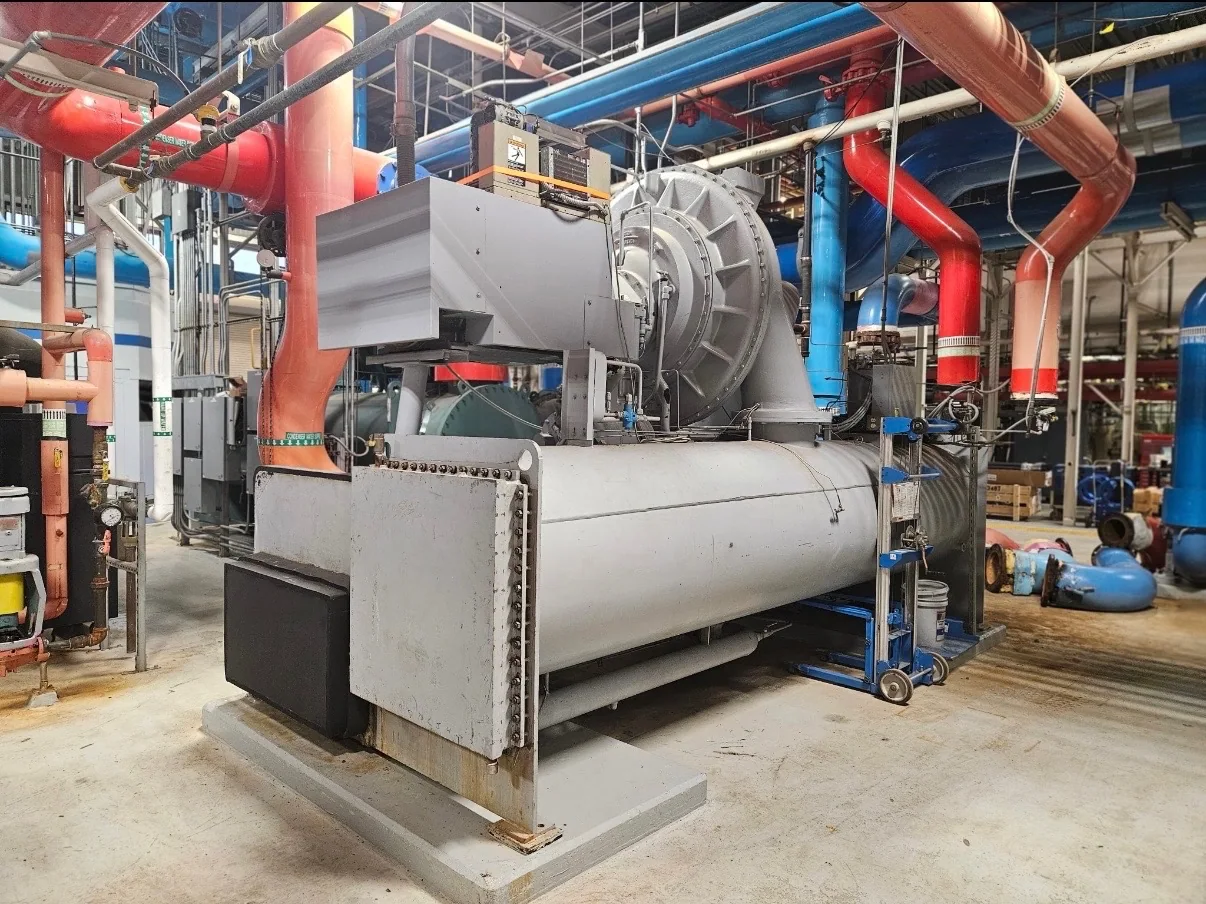
A practical way to sell your industrial chiller
Whether a chiller is still connected or has already been retired, its owner can ask us about a sale. We buy industrial chillers in Murfreesboro, Tennessee. With data center chillers, we need an accurate picture of the equipment, its surroundings and the likely release window; a running demonstration is not required for our review.
Use this page as a starting point for the following: data center closure, equipment decommissioning and project sequencing. The particular nameplate, condition and site constraints matter more than a general description; uncertain details can be discussed rather than guessed.
We purchase industrial chillers, including equipment released by data-center decommissioning, power-plant shutdowns, hospital and campus closures and industrial shutdowns. Both water-cooled and air-cooled machines can be considered, including scroll, screw and centrifugal types. We buy chillers of all tonnages and using all refrigerants, including units from 20 to 2,000 or more tons. Cash offers with upfront payment depend on review and agreed terms; no offer is assured.
Planning around the facility timeline
For a data center decommissioning, identify which chiller is actually being retired and whether neighboring cooling equipment must remain available. A site contact can explain redundancy requirements, security procedures and the window in which the unit will be released. We can plan the purchase and removal around the information provided rather than assuming the entire facility is shutting down.
If the equipment is on a roof, in a plant room or behind controlled-access doors, describe that route and any escort or loading restrictions. Share the identification of the unit to be sold, not just a list of cooling assets. No performance test is needed for our buying process.
Access, rigging and removal
A good removal plan begins with the route out. Show the surrounding room, available openings, any overhead obstructions and the intended loading area. Tell us about roof access, restricted driveways or equipment that cannot be moved. If you have measurements or a documented weight, include them; if not, share clear photos rather than guessing.
The buyer handles crane work when needed, rigging, refrigerant recovery, disconnects, loading, freight and hauling. Tell us about electrical connections, water piping and other nearby systems that must remain in service. The site contact should explain its access rules and release requirements; we can then coordinate the agreed work and timing. No seller-performed testing is needed.
From first details to an agreed pickup
To begin, provide a contact name and company, the equipment location, and the type, tonnage, refrigerant and voltage shown on the chiller if known. Nameplate and full-unit photos help connect those details to the correct machine. Mention who can authorize the sale and your preferred release window; an unknown specification or tentative date can be marked as such.
The review comes before a commitment. We may need clarification on the unit, its connections or the release date; an offer is not automatic. If a proposal is made, compare its equipment, payment and removal terms with your plans. Once accepted, we pay upfront as agreed and arrange the removal and freight with the appropriate site contact.
What to send for a useful equipment review
Make the identification images easy to match to the asset. A close view of the main plate may show the manufacturer, model, serial number, capacity, voltage and refrigerant; a separate wide view shows the whole chiller. If safe access permits, add controls and connection photographs. Do not open electrical enclosures or remove protective guards to obtain them.
An incomplete record does not need to become a guess. Tell us which components are visibly missing, whether the chiller remains connected and what is known about its condition. A worn label can be supplemented by existing documentation. No performance test is required; leave a retired or disconnected machine off rather than starting it for a quote.
How we evaluate an offer
A quote has to account for two connected questions: what is being bought, and what work is needed to take it away? Model, capacity, configuration, completeness and visible condition inform the equipment side. Disconnects, the exit route, freight and release date inform the logistics side. We review the whole situation; none of those details guarantees an offer or price.
If an offer is made and accepted, we pay upfront as set out in the agreed sale terms. Confirm the equipment included, payment arrangements and anticipated removal window before the work is scheduled. We cover all freight and handle hauling; the quote should make the agreed scope clear so both sides know what is being purchased and removed.
Frequently asked questions
Do disconnected machines need to be reconnected for review?
No. Tell us the chiller is disconnected and send available identification and site photos instead. We do not ask sellers to operate or test equipment to request an offer. Describe missing components and leave uncertain details marked as unknown.
Must the seller disconnect the machine before pickup?
The buyer handles the agreed disconnects and refrigerant recovery, together with rigging, crane work when needed, loading, freight and hauling. All freight is covered. Identify power and water connections and any nearby systems that must remain in service.
How do multiple project milestones affect pickup?
Tell us if the chiller's release depends on another contractor, an access approval or a changing shutdown schedule. Identify the authorized seller and any nearby systems that must remain in service. An estimated date can be discussed before the agreed work window is confirmed.